
What if that hairline crack across your bespoke marble tile didn’t mean a week of dust, loud drilling, and a five-figure renovation bill? For many homeowners and tenants in the capital, a single damaged surface feels like a disaster that’s bound to result in a lost security deposit or a spoilt luxury aesthetic. You’ve probably been told that once a tile is chipped, the only solution is to rip everything out and start again, but that’s rarely the most sustainable or sensible path forward.
We understand the stress of seeing a beautiful space compromised by a sudden accident. This is why we’ve developed a professional approach to bathroom wall tile repair London that focuses on precision craftsmanship rather than demolition. By choosing restoration over replacement, you can achieve a seamless, invisible finish whilst keeping your existing materials out of the landfill. In this article, you’ll discover our ultimate 2026 restoration checklist to help you decide if your tiles can be expertly salvaged. We’ll explore the technical limits of modern repairs, the benefits of quick, on-site service, and how to protect your investment without the mess of a full bathroom refit.
Key Takeaways
- Learn how to identify if your damaged surfaces are suitable for a professional bathroom wall tile repair London before committing to an expensive and unnecessary replacement.
- Understand why London’s unique property landscape, from shifting Victorian terraces to settling new builds, makes restoration a more practical choice than renovation.
- Discover the “50p rule” and other essential criteria in our 2026 checklist to determine if a chip or crack can be made completely invisible.
- Compare the significant time and cost benefits of a targeted on-site repair, a favoured solution for landlords looking to protect their security deposits and property value.
- Explore the specialist techniques used to clean, fill, and colour-match tiles to achieve a premium finish without the dust and disruption of a full refit.
Understanding Bathroom Wall Tile Damage in London Homes
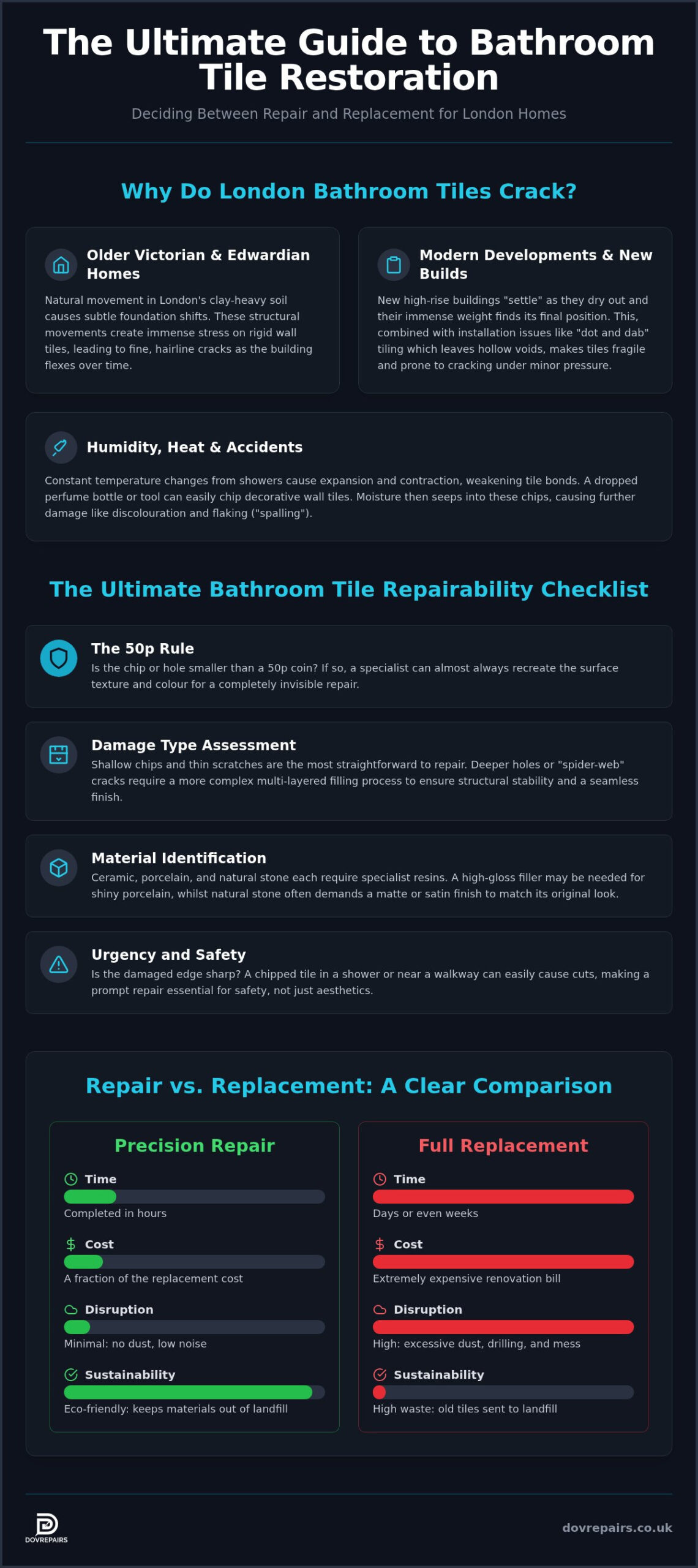
London bathrooms face unique pressures that vary significantly depending on the age of the property. In older Victorian and Edwardian terraces, the natural movement of the city’s clay-heavy soil often causes subtle shifts in foundations. This movement translates into hairline cracks across your walls as the rigid tiles struggle to flex with the building. In contrast, modern developments in areas like Canary Wharf or Nine Elms experience “settling,” where the immense weight of a new high-rise causes the structure to find its final position over several years. Both scenarios put immense stress on ceramic and porcelain surfaces.
Beyond structural movement, everyday accidents are the most frequent reason for requesting bathroom wall tile repair London. A dropped glass perfume bottle or a slip whilst installing a new mirror can easily chip a glazed surface. Wall tiles are particularly vulnerable because they sit at eye level, where even a tiny 2mm nick catches the light and spoils the room’s luxury aesthetic. Unlike floor tiles, which are usually thicker and built for impact, wall tiles prioritise decorative finish and colour, making them far more prone to visible surface damage and unsightly “spider-web” cracks.
New-Build Snagging: Why Your New Tiles Might Crack
If you’ve recently moved into a modern development, you might be surprised to find cracks appearing within the first year. Building settlement is a primary culprit, as the new structure dries out and shifts. However, installation errors often play a role. If a tiler used the “dot and dab” method instead of a full bed of adhesive, it leaves hollow voids behind the tile. These unsupported areas are incredibly fragile and can crack under the slightest pressure. Engaging a new build snagging surface repairs specialist ensures these defects are corrected invisibly, preserving your home’s pristine look whilst the building stabilises.
The Role of Humidity and Heat in Tile Degradation
The Ultimate Bathroom Tile Repairability Checklist
Before you decide to rip out a damaged wall, use this diagnostic checklist to see if a professional restoration is possible. Most surface damage can be rectified on-site, but certain factors determine how “invisible” the final result will be. We’ve found that catching these issues early often prevents moisture from compromising the substrate behind your tiles.
- The 50p Rule: A helpful gauge for repairability is the size of a 50p piece. If the chip or hole is smaller than this, a specialist can usually recreate the surface textures so accurately that the damage becomes invisible to the naked eye.
- Surface Assessment: Is the damage a shallow chip, a deep hole, or a thin scratch? Shallow chips are the most straightforward to resolve, whilst deep holes require a multi-layered filling process to ensure structural stability.
- Material Identification: Whether you have classic ceramic, dense porcelain, or porous natural stone, each material requires a specific restoration resin. Natural stone often needs a matte or satin finish, whereas porcelain might require a high-gloss UV-stable filler to match its reflective properties.
- Urgency and Safety: Beyond the aesthetic spoil, determine if the damage is sharp. A chipped tile in a shower can easily cut skin, making a prompt bathroom wall tile repair London a matter of safety rather than just style.
If you’re unsure about the extent of the damage in your own home, you can always request a professional assessment to confirm the best course of action for your specific surfaces.
Diagnostic Step 1: Surface Chips and Scratches
Impact damage from a dropped hairdryer or perfume bottle usually results in a clean surface chip. These are prime candidates for restoration because the surrounding tile remains structurally sound. Scratches on high-gloss tiles, often caused by abrasive cleaning or accidental contact with metal tools, can often be polished out using specialist abrasive pads and compounds. Surface restoration is the art of rebuilding the tile’s profile and colour.
Diagnostic Step 2: Cracks and Structural Integrity
It’s vital to distinguish between a surface crack and a structural fracture. A fracture that goes all the way through the tile often suggests the wall behind it is moving. Whilst we can fill these, they may reappear if the building continues to settle. You should also check for “hollow” tiles by gently tapping the surface. If a tile sounds hollow, it has likely detached from the adhesive and may need re-fixing before we can perform a bathroom wall tile repair London to ensure the finish lasts.
Grout and Tile Repair London: Repair vs. Replace
Choosing between a localised restoration and a full surface replacement often comes down to the practicalities of London living. If you opt for a complete retile, you aren’t just paying for new materials. You’re also inviting days of dust, the noise of pneumatic drills, and the logistical headache of skip hire on a narrow city street. A professional bathroom wall tile repair London offers a surgical alternative. Most repairs are completed within a few hours, allowing you to use your bathroom the same evening without having to coordinate multiple tradespeople.
For London landlords and property managers, this efficiency is a significant advantage. Minimising “void periods” between tenancies is essential for maintaining rental income. A single chipped tile might seem minor, but it can lead to disputes over security deposits or, worse, allow water to seep into the wall structure. By restoring the surface to its former glory, you protect the property’s value whilst avoiding the high quotes associated with a full renovation. It’s a pragmatic choice that delivers a premium finish without the premium price tag of a total refit.
The “Ghost Tile” Problem: Matching Discontinued Ranges
One of the most common frustrations homeowners face is the “ghost tile.” If your bathroom was installed more than five years ago, the chances of finding an exact match at a local showroom are slim. Batches vary in shade, and manufacturers frequently discontinue ranges to make room for new trends. This often forces people into a full renovation simply because they can’t find one replacement square. Our specialists bypass this issue by using advanced pigment-matching techniques. We recreate the exact hue and veining of your existing surface on-site. For a more detailed look at how we handle different finishes, see our ceramic tile chip repair London guide.
Sustainability and the Circular Economy in London
The environmental impact of the construction industry is becoming an increasingly urgent concern in the capital. Manufacturing a single ceramic tile requires high-temperature kilns and significant water usage, not to mention the carbon footprint of transporting heavy pallets across the country. Choosing to “restore, don’t remove” keeps perfectly functional materials out of London’s overstretched landfills. It’s a small but meaningful contribution to a zero-waste lifestyle. Preserving original period features in Victorian conversions also maintains the historical character of our city’s architecture, ensuring that craftsmanship is valued over disposable convenience.
What to Expect During a Professional Tile Restoration
A professional restoration is a highly disciplined process that combines chemical engineering with fine art. When you book a bathroom wall tile repair London, the technician arrives with a mobile laboratory of resins and pigments. The first task is meticulous preparation. We must remove every trace of soap scum, limescale, and bathroom oils. Without this clinical level of degreasing, the repair resin won’t bond permanently to the ceramic or porcelain surface. It’s a vital step that ensures the longevity of the finish.
Once the area is prepared, we rebuild the missing section using specialist fillers. These aren’t standard DIY putties. They are high-strength resins designed to mimic the density and durability of the original tile. After the structural fill is level, the artist’s work begins. We hand-tint the resin on a palette, mixing primary pigments until we achieve a perfect match for your tile’s specific shade and depth of colour. The final stage involves levelling the surface precisely and applying a protective coat. This ensures the repair has the same reflective properties as the rest of the wall, whether it’s a high-gloss modern finish or a satin period style.
The Art of the Invisible Repair
The secret to a truly “vanishing” repair lies in a technique called feathering. Instead of a hard border between the filler and the tile, we subtly blend the edges so the eye cannot find the transition. Technicians also replicate complex patterns like marble veining or the subtle stippling of natural stone using fine-tipped brushes and steady hands. This work is performed under high-CRI (Colour Rendering Index) lighting. This ensures the colour remains accurate under both the cool morning sun and warm evening spotlights, providing a seamless aesthetic from every angle.
After-Care: Maintaining Your Restored Surface
Maintaining your restored surface is straightforward. For the first 24 hours, it’s best to avoid using the shower to allow the resins to reach full hardness. Once cured, these modern materials are incredibly durable and resistant to the usual humidity of a London bathroom. However, you should avoid abrasive cleaners or harsh bleach. A gentle, pH-neutral soap is all you need to keep the finish looking pristine. If you’re ready to see these results in your own home, you can book your professional tile restoration today and enjoy a flawless finish without the stress of a renovation.
Specialist Bathroom Wall Tile Repair London: The DovRepairs Approach
At DovRepairs, we operate with a deep commitment to what we call conscientious restoration. We don’t just fill holes. We provide a disciplined, expert service designed to restore your peace of mind along with your surfaces. Whether you are a homeowner in a Chelsea flat dealing with a single unsightly chip or a developer managing a complex commercial snagging list in a new Greenwich high-rise, our approach remains the same. We combine technical precision with a genuine desire to be helpful, ensuring every client feels supported through a stress-free repair journey.
Our work is grounded in the belief that repair is almost always better than replacement. By focusing on high-quality craftsmanship, we help our clients maintain the luxury aesthetic of their bathrooms whilst actively reducing the amount of construction waste sent to landfill. This ethical stance is backed by a guarantee of professional workmanship and dedicated after-care support. We want you to feel confident that your restored tile will stand up to the rigours of daily London life for years to come.
Serving the Capital: Our London Coverage
Our team provides comprehensive coverage across the entire capital. We regularly visit clients from the bustling square mile of the City to the leafy Greater London suburbs and out towards Dartford. Because we understand that your time is valuable, our technicians are trained to be highly efficient whilst on-site. We can often address multiple surface issues in a single visit. For instance, many of our clients choose to combine their wall restoration with a professional bath chip repair London to refresh their entire suite at once.
Getting started is simple and transparent. You don’t need to wait for a surveyor to visit your home. By sending us a few clear photos of your damaged tiles, you can receive a free, accurate assessment. This methodical process allows us to prepare the correct resins and pigments before we even arrive, ensuring a swift and successful restoration on the day.
In the fast-paced London rental market, speed and reliability are paramount. Letting agents and landlords frequently turn to us because we can get a property ready for new tenants within hours rather than days. For tenants, our service is a vital resource for those looking to save their security deposit after an accidental spill or impact. DovRepairs provides a reliable, ethical alternative to costly renovations. By opting for a localised fix, you avoid the high costs of full replacements and the potential for deposit deductions, making it a pragmatic choice for everyone involved in the London property cycle.
Restore Your Bathroom’s Flawless Finish Today
A chipped or cracked tile doesn’t have to signal the end of your bathroom’s luxury aesthetic or the loss of a rental deposit. As we’ve explored, professional bathroom wall tile repair London offers a sophisticated, sustainable alternative to the chaos of a full renovation. By choosing restoration, you save yourself the disruption of a multi-day refit whilst keeping perfectly good materials out of the landfill. It’s a pragmatic decision that prioritises both your peace of mind and the environment.
Whether you’re dealing with structural settling in a new build or accidental damage in a period home, our conscientious specialists are here to help. We provide expert colour matching for all tile types and guaranteed professional workmanship across London and the M25 region. Don’t let a minor imperfection spoil your space when a seamless, invisible finish is just a few hours away. You can Request a Free Quote for Bathroom Tile Repair by sending us a photo of your damaged surfaces. We look forward to helping you return your home to its former glory with ease and integrity.
Frequently Asked Questions
Can you repair a cracked bathroom tile without removing it?
Yes, we can repair cracks without any removal. We use high-performance resins that bond directly into the fracture, stabilising the tile and preventing further spread. This method avoids the risk of damaging neighbouring tiles or the waterproof membrane behind the wall. It’s an ideal solution for hairline fractures caused by building settlement or thermal expansion. The process is clean, quiet, and doesn’t require any structural building work or plumbing alterations.
How much does bathroom wall tile repair cost in London?
Costs for bathroom wall tile repair London vary based on the extent of the damage and the materials involved. Factors such as the number of chips, the complexity of the tile pattern, and the total time required on-site all influence the final quote. Whilst we don’t provide a fixed price list, we offer free assessments based on photos you provide. This ensures you receive a transparent and accurate estimate tailored to your specific restoration needs.
Will the tile repair be completely invisible?
Most professional repairs are virtually invisible to the naked eye. We achieve this through meticulous hand-tinting of pigments to match your tile’s base colour and any unique surface patterns. By feathering the edges of the repair, we remove the harsh borders that usually draw the eye. Whilst the finish is designed to be seamless, the final result can depend on the tile’s original texture and the lighting conditions in your specific bathroom.
How long does a professional tile repair take to complete?
A standard repair for a few chips or a single crack typically takes between one and three hours to complete. This is significantly faster than a traditional retiling job, which often requires multiple days for removal, setting, and grouting. Because our process is performed on-site with minimal mess, you can usually return to using your bathroom the same evening. It’s an efficient way to restore your home without the stress of a long renovation.
Can you match the colour of my existing grout?
Yes, we can match your existing grout colour as part of the restoration process. Grout often discolours over time due to moisture and cleaning products, so we don’t just use a standard white or grey. Instead, we tint our filler materials to blend perfectly with the current state of your grout lines. This ensures that the repaired section doesn’t stand out against the surrounding wall, maintaining a consistent and professional aesthetic.
Is a repaired tile as strong as a new one?
Modern restoration resins are engineered to be incredibly durable and moisture-resistant. Once fully cured, the repaired area is often as hard as the original ceramic or porcelain surface. It’s designed to withstand the high humidity and temperature fluctuations common in London bathrooms. Whilst the repair won’t fix underlying structural issues with the building’s movement, it provides a long-lasting and robust solution for surface-level damage and chips caused by daily use.
What areas of London do you cover for tile repairs?
We provide comprehensive coverage for bathroom wall tile repair London across all boroughs and the wider M25 region. Our technicians regularly visit residential and commercial properties from central locations like the City and Westminster to outer areas such as Bromley, Enfield, and Dartford. No matter where you are located within the capital’s main transport loop, we can bring our specialist restoration laboratory directly to your door at a time that suits your schedule.
Can you fix holes in tiles where towel rails or mirrors were removed?
Yes, filling old drill holes is one of our most frequent requests. When towel rails, mirrors, or shower caddies are moved, they often leave unsightly and potentially hazardous holes in the tiles. We carefully clean these voids before filling them with a structural resin that matches your tile’s colour and sheen. This is a perfect solution for tenants looking to restore a wall to its original condition before a final property inspection.