
Imagine you’re just days away from your checkout inspection in a busy London borough, only to notice a deep chip in the granite worktop or a nasty scratch on the laminate flooring that you’ve been hiding under a rug for months. It’s a sinking feeling that many tenants know all too well. Moving house is already one of life’s most stressful events, and with the Renters’ Rights Act 2025 now in full effect, ensuring your property is in top condition has never been more important for your financial peace of mind.
You likely fear that your landlord will use these minor surface imperfections as an excuse to claim hundreds of pounds from your deposit for full replacements. This is where our end of tenancy surface repair checklist London becomes your most valuable asset. We’ll help you distinguish between fair wear and tear and actionable damage, ensuring you don’t pay for “betterment” that you aren’t legally responsible for according to current TDS guidelines.
In this guide, you’ll learn how to professionally restore everything from chipped bath enamel to scorched kitchen units. We’ll walk through the specific areas inventory clerks scrutinise most, helping you secure your full deposit return whilst making an eco-friendly choice that keeps quality materials out of the landfill.
Key Takeaways
- Learn to distinguish between fair wear and tear and accidental damage, such as impact marks or perfume spills, to challenge unfair deposit deductions effectively.
- Utilise a comprehensive end of tenancy surface repair checklist London to audit high-traffic areas like kitchen worktops and bathroom tiles before your final inspection.
- Discover how professional on-site restoration uses advanced colour-matching technology to provide invisible repairs for wood, laminate, and stone surfaces.
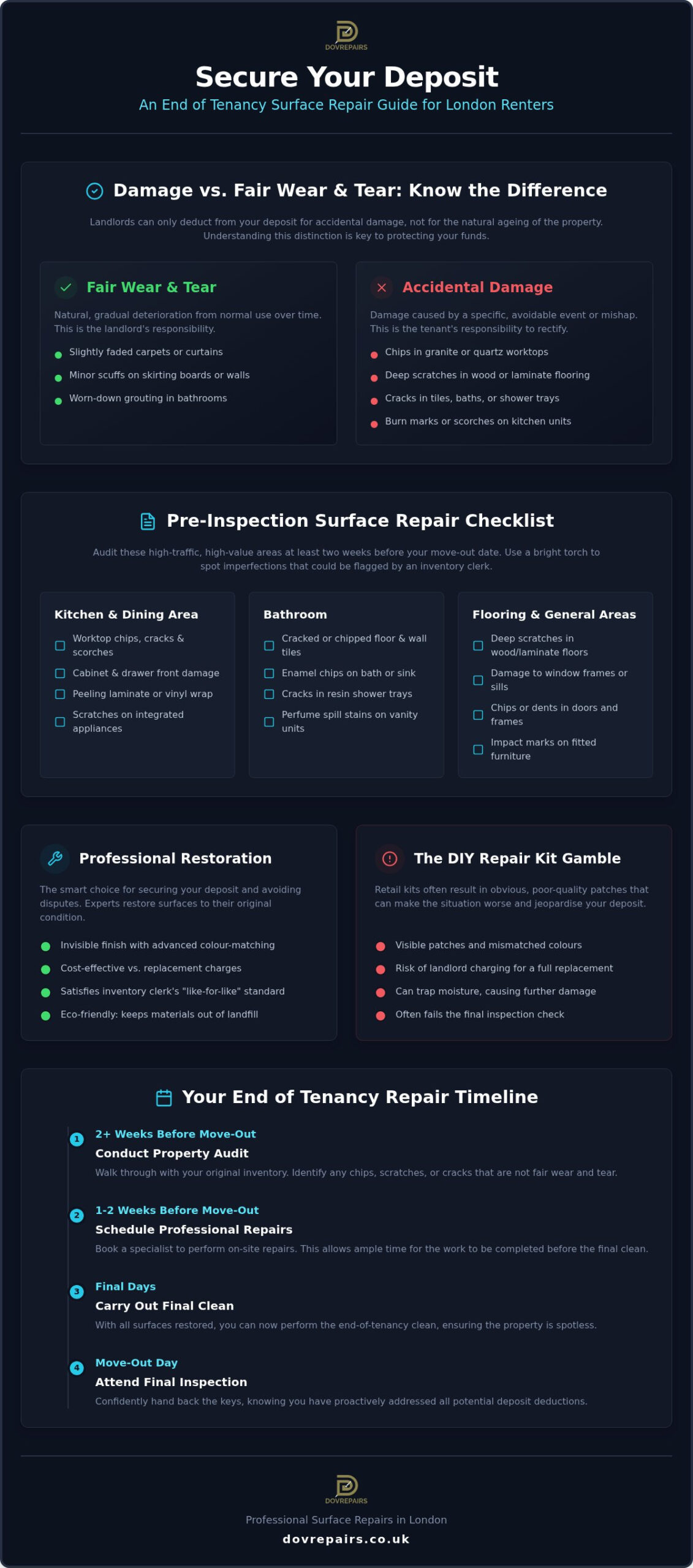
- Schedule your pre-inspection walk-through at least two weeks before your move-out date to allow ample time for comparing the property’s condition to your original inventory.
- Understand the financial risks of using retail DIY kits, which often result in visible patches that could lead to a landlord charging you for a full replacement.
Understanding Deposit Deductions: Damage vs Fair Wear and Tear
Moving out of a London flat often feels like a high-stakes negotiation. You’ve lived in the space, and naturally, the surfaces show it. The central question for any tenant is where “living” ends and “damage” begins. Under the current tenancy deposit scheme rules in 2026, landlords cannot charge you for the natural, gradual deterioration of the property. This is known as fair wear and tear. A slightly faded carpet or minor scuffs on a skirting board are expected results of daily life.
Using a professional end of tenancy surface repair checklist London helps you spot the difference before the inventory clerk arrives for the final walk-through. If you leave a visible chip in a quartz worktop or a burn mark on a laminate surface, a landlord won’t usually spend time looking for a repair specialist. Instead, they’ll likely provide a quote for a full replacement. Since a new worktop can cost thousands of pounds, even a partial deduction for “depreciated value” can significantly impact your security deposit return. Understanding how landlord surface repair London specialists approach these same issues from the property owner’s perspective can help you anticipate exactly what your landlord is likely to claim and why.
What Qualifies as Accidental Damage?
Accidental damage is anything caused by a specific, avoidable event. It isn’t the result of time; it’s the result of a mishap. These marks are considered “impact events” and fall outside the protection of fair wear and tear. Common triggers we see across Greater London include:
- Chips in quartz, granite, or laminate worktops caused by dropped heavy pans or kitchen utensils.
- Deep scratches in wood or laminate flooring resulting from dragging heavy furniture without protectors.
- Cracks in resin shower trays or enamel bath chips from dropped perfume bottles or heavy bathroom accessories.
The Landlord’s Right to Betterment
UK rental law is built on the principle that a landlord shouldn’t end up in a better financial or material position than they were at the start of the tenancy. This is called “betterment.” If you damage a five-year-old kitchen unit, the landlord can’t legally charge you for the full cost of a brand-new replacement. They’re only entitled to the remaining value of the original item.
Professional restoration is the most ethical and cost-effective way to settle these potential disputes. By choosing an invisible repair, you return the surface to its pre-accident state without the unnecessary waste of a full replacement. It’s a disciplined approach that satisfies the inventory clerk’s “like-for-like” requirement whilst keeping your deposit intact. Leaving these issues until the final snagging is a financial risk you don’t need to take when a specialist repair can resolve the problem for a fraction of the cost.
The London Tenant’s Checklist for Repairable Surfaces
To ensure you secure your full deposit return, you must approach your final weeks in a property with the eye of a professional inventory clerk. Most modern London apartments are finished with high-specification materials that look stunning but are susceptible to impact damage. Using a methodical end of tenancy surface repair checklist London allows you to spot issues whilst there is still time to act. When you conduct your audit, it’s vital to differentiate between structural failure and surface-level aesthetic damage. If a kitchen cabinet door is falling off its hinges, that’s a structural fix; if the laminate surface is chipped or peeling, it’s an aesthetic repair that can be restored invisibly on-site.
Acting quickly is essential for certain materials. If a scratch on a laminate floor or a chip in a stone worktop is left exposed, moisture can seep into the core material, causing it to swell or stain. This turns a simple restoration into a much larger problem. Before you book your final clean, take an hour to walk through every room with a high-powered torch to identify imperfections that your landlord might flag under a government-approved tenancy deposit scheme audit.
Kitchen and Dining Area Checklist
The kitchen is often the most expensive room to “make right” if damage is found. You should carefully inspect the edges of your counters, as this is where most impact marks occur. If you find any damage, seeking a professional worktop repair London specialist can save you from a four-figure replacement bill. Your audit should also include:
- Kitchen unit doors: Look for peeling edges near the kettle or dishwasher where heat and steam may have caused the foil to lift.
- Stainless steel surfaces: Check hobs and sinks for deep scratches that won’t buff out with standard cleaning.
- Dining surfaces: Inspect any integrated breakfast bars or stone islands for dull rings or small chips caused by heavy cookware.
Bathroom and Flooring Audit
Bathrooms are high-risk zones due to the fragile nature of ceramic and acrylic. A dropped perfume bottle can easily cause a star-shaped crack or a deep chip. We recommend checking for bath chip repair London needs by running your hand along the internal surface of the tub to feel for snags. Similarly, wall and floor tiles should be scanned for hairline cracks; a specialist ceramic tile chip repair London service can fill and colour-match these so they vanish completely.
Finally, examine your flooring. Laminate and wood floors in high-traffic London hallways often suffer from “dirt trapping” in deep scratches, which makes the damage look significantly worse than it is. If you’re unsure whether a mark is repairable, sharing a photo with a restoration expert can provide immediate clarity and peace of mind before your move-out date.
The Professional Restoration Process: Invisible On-Site Fixes
Professional restoration is a craft that blends technical science with artistic precision. It’s a non-invasive process that allows us to work directly in your London home without the need for dusty demolition or lengthy lead times. Whilst a landlord might suggest that a chipped worktop requires a total kitchen overhaul, our on-site methodology proves otherwise. We use advanced colour-matching technology to recreate the exact shade and depth of your damaged surface, ensuring the result is indistinguishable from the original material. This isn’t a temporary cover-up; it’s a permanent restoration that respects the integrity of the existing installation.
Unlike retail fillers that often shrink or crack over time, we use high-grade industrial resins. These materials cure quickly, often allowing you to return the surface to normal use within just a few hours. This speed is vital when you’re working through your end of tenancy surface repair checklist London and the checkout date is looming. The durability of these professional resins ensures that the fix won’t just look good for the photos; it will withstand the scrutiny of a physical inspection. By choosing restoration, you’re also making a conscientious choice for the environment by keeping quality materials out of the landfill. Tenants and homeowners across the region can benefit from professional surface damage repair M25 area services that offer a seamless, sustainable alternative to costly full replacements.
Seamless Colour and Texture Matching
Achieving an invisible finish requires more than just picking the right paint. Our specialists are trained to recreate the natural movement found in stone surfaces like granite or marble, as well as the intricate grain patterns of timber and laminate. We use UV-stable resins to ensure the repair doesn’t yellow or fade when exposed to sunlight through a window. Matching the sheen level is equally important. Whether your surface is high-gloss, satin, or matte, we calibrate the finish so it catches the light in exactly the same way as the surrounding area, making the repair impossible to spot even from a side angle.
Structural Integrity for Checkout Success
A repair that looks good but fails under heat or moisture won’t pass a rigorous checkout. Our restoration process ensures that kitchen worktops remain heat-resistant and bathroom surfaces stay completely waterproof. DovRepairs provides guaranteed workmanship as standard, giving you the confidence that the repair meets professional standards. To keep the repair invisible until the inventory clerk arrives, we recommend following these simple maintenance steps:
- Avoid abrasive cleaners: Use only non-acidic, gentle detergents on the restored area.
- Soft cleaning: A simple wipe with a soft, damp cloth is usually all that’s needed to maintain the finish.
- Heat protection: Whilst the repair is durable, always use coasters or heat mats as you would on any high-quality surface.
Planning Your End of Tenancy Repairs: Timing and Logistics
Success in reclaiming your deposit depends on proactive planning. We recommend performing your own “pre-inspection” walk-through at least two weeks before your checkout date. This window gives you enough time to cross-reference the current state of your surfaces with the original check-in inventory. It’s easy to overlook a small chip when you’re surrounded by packing boxes, so clear each area before you inspect it. You should also aim to check these surfaces in natural London sunlight. Artificial bulbs can hide sheen variations that a professional inventory clerk will spot instantly during their mid-day inspection.
Logistics are equally important. Always coordinate with your professional cleaners to ensure repairs are completed before the deep clean begins. This prevents cleaning chemicals from interfering with the curing process and ensures the technician has a clear, accessible workspace. If you’re ready to finalise your end of tenancy surface repair checklist London, booking your restoration early is the best way to secure your full deposit return without last-minute panic.
Timing Your Professional Restoration
Scheduling is everything when you’re moving house. Leaving repairs until the day before checkout is a high-stress mistake that limits your options. Professional resins need time to reach their full hardness, and whilst many surfaces are touch-dry quickly, they benefit from a full 24-hour curing period before being subjected to a rigorous checkout clean. This careful timing ensures the finish is durable enough to withstand the scrutiny of the inventory clerk. This is especially true if you’re transitioning into a new home and need new build snagging surface repair London to ensure your next property is as perfect as the one you’re leaving behind.
Evidence and Documentation for the Deposit Return
Once the restoration is complete, document the results carefully. Take high-quality “after” photos of the restored surface from multiple angles. These serve as your primary evidence if a landlord or letting agent questions a mark that was noted in a previous inspection. Keeping your receipts for all professional services is a vital part of your end of tenancy surface repair checklist London strategy. This documentation demonstrates due diligence and proves that any damage has been resolved to a trade-standard level. If a clerk identifies a previous repair, you can confidently present the receipt to show the work was carried out by a specialist rather than being a botched DIY attempt.
Why DIY Repair Kits Risk Your Security Deposit
It’s tempting to reach for a cheap repair kit found online when you’re trying to tick items off your end of tenancy surface repair checklist London. These “one-size-fits-all” solutions promise a quick fix, but they often lack the technical depth required for a high-standard restoration. A botched DIY attempt is often more visible than the original damage, acting as a red flag for professional inventory clerks who are trained to spot non-standard modifications. When a landlord sees a visible patch, it suggests that damage was concealed rather than resolved, which often triggers a full replacement quote rather than a repair deduction.
There’s also a significant risk of causing secondary damage to the surrounding area. Many retail kits include harsh chemicals or abrasive sanding pads that can etch the finish of expensive stone worktops or cloud the sheen of a laminate floor. If you use the wrong product on a high-value London surface, you might turn a small chip into a large, permanent blemish. This often leads to a “double charge” for the tenant, where you’re billed for the original damage plus the professional labour required to remove the failed DIY filler before a proper repair can even begin.
The Hidden Costs of Cheap Kits
Retail kits typically offer a limited range of basic colours. Without the ability to custom-blend pigments on-site, you’ll likely end up with a patch that doesn’t quite match the surrounding surface. This poor colour matching actually draws the eye directly to the damage you’re trying to hide. Many of these fillers also lack the structural integrity of professional resins; they often shrink as they dry or fall out the first time the surface is cleaned with a damp cloth. This lack of longevity is a major risk if your checkout inspection happens several days after you apply the fix.
The DovRepairs London Specialist Advantage
Choosing a professional service removes this uncertainty and provides immediate peace of mind. From our base in Dartford, we provide a mobile restoration service that covers the entire M25 region and Greater London. Our specialists possess deep technical expertise across wood, laminate, stone, and stainless steel, ensuring that every repair is tailored to the specific material in your home. We don’t just fill a hole; we recreate the surface using trade-only resins and precision colour-matching tools that stand up to the scrutiny of any professional inventory clerk.
This methodical approach is the most cost-effective way to secure your full deposit return. It avoids the stress of a rejected repair and ensures your move-out process remains smooth and ethical. By trusting a conscientious specialist, you’re choosing a durable, invisible finish that protects your finances and respects the quality of the property’s original materials. It’s a disciplined solution that transforms a potential conflict into a seamless transition to your next home.
Secure Your Full Deposit Return with Ease
Passing your checkout inspection doesn’t have to be a source of anxiety. By following a structured end of tenancy surface repair checklist London, you can identify issues early and address them before they become expensive disputes. We’ve explored how professional restoration offers a seamless, eco-friendly alternative to full replacements, ensuring your landlord receives the property in the condition required whilst you keep your security deposit intact.
Our team at DovRepairs provides professional workmanship guarantees on all restorations, giving you total peace of mind during your move. We are specialists in stone, wood, metal, and ceramic surfaces, serving tenants across London, Dartford, and the entire M25 area. Don’t risk a botched DIY fix or an unfair deduction from your deposit when a specialist finish is just a photo away.
Get a fast photo quote to save your deposit today and take the first step towards a stress-free moving day. You’ve looked after your home; now let us help you move on with confidence.
Frequently Asked Questions
Will my landlord be able to tell a surface has been repaired?
Most professional restorations are virtually invisible to the naked eye, even under the scrutiny of a professional inventory clerk. By using advanced colour-matching technology and recreating the original texture of the material, we ensure the repair blends seamlessly with the surrounding area. This level of precision is essential for anyone following an end of tenancy surface repair checklist London to ensure they pass their final checkout inspection without any raised eyebrows.
How much does professional surface repair cost compared to a deposit deduction?
Professional surface restoration is significantly more cost-effective than the heavy deductions landlords often claim for full replacements. Whilst we don’t provide fixed pricing without seeing the damage, a repair typically costs a small fraction of a new stone worktop or a complete bathroom suite. Choosing a specialist repair avoids the financial risk of “betterment” disputes and ensures you only pay for the restoration of the specific area you’ve damaged.
Can you fix a deep scratch in a laminate floor before I move out?
Yes, deep scratches in wood and laminate flooring are among our most common requests for tenants moving out of London properties. We use high-density fillers and precision grain-painting techniques to hide the scratch and protect the core of the laminate from moisture. It’s a durable solution that returns the floor to its pre-accident state, preventing the landlord from flagging the mark as “damage” rather than fair wear and tear.
Do you provide a guarantee that the repair will last through the inspection?
Most on-site repairs in London flats are completed within two to four hours, depending on the scale and complexity of the damage. Since we work directly on the existing surface, there’s no need for lengthy demolition or waiting for replacement parts to be delivered. This efficiency is perfect for tenants who need a quick, reliable solution in the final days before their tenancy officially ends and the checkout clerk arrives.
Are the repair materials safe for kitchen food preparation areas?
The resins and coatings we use are specifically designed to be safe for kitchen environments once they have fully cured. They are heat-resistant and moisture-proof, making them ideal for worktop repairs and kitchen unit restorations. We ensure the finish is durable enough for daily food preparation, providing a hygienic surface that meets the high standards expected by letting agents and landlords across the capital.
Do you cover all areas of Greater London and the M25?
Our mobile restoration team covers all boroughs within Greater London and the entire M25 region. Operating from our central base in Dartford, we are well-positioned to reach clients in East, West, North, and South London quickly. This local expertise allows us to respond promptly to checkout deadlines, providing a dependable service for tenants who need surface damage repair M25 area specialists to secure their security deposit return.
Can you repair a cracked shower tray without having to remove it?
We specialise in repairing cracks in resin, acrylic, and enamel shower trays on-site without any need for removal or plumbing work. By using structural resins that bond directly with the material, we can restore the tray’s integrity and appearance in a single visit. This non-invasive approach saves you from the massive expense of replacing the entire unit and the potential plumbing costs associated with a full bathroom renovation.