
What if that deep gouge in your hallway didn’t mean ripping up the entire floor before your landlord’s next inspection? It’s incredibly frustrating when a dropped mug or a heavy piece of furniture leaves a permanent mark on your flooring, especially in high-traffic areas where every scratch feels magnified. You have likely looked at DIY wax kits and wondered if they’ll actually work or simply make the damage stand out more whilst you worry about your rental deposit.
We understand that your home is your sanctuary, and maintaining its condition shouldn’t always require a costly, disruptive replacement. This ultimate guide to laminate floor repair London will teach you how to identify specific types of damage and help you decide when a professional restoration is the most sustainable, cost-effective choice. You will learn the secrets to achieving a seamless, distraction-free finish that saves your floor and your budget. We will walk you through the differences between home fixes and expert craftsmanship, the restoration process for various textures, and how to ensure your repairs remain durable for years to come.
Key Takeaways
- Distinguish between superficial scratches and structural plank failure to determine if your floor is a candidate for a simple restoration.
- Discover the essential toolkit for minor DIY fixes, including the correct way to use wax sticks and fillers for subtle results.
- Understand the artistic process behind a professional laminate floor repair London that creates a seamless, distraction-free finish in high-traffic areas.
- Evaluate the environmental and financial benefits of choosing targeted surface repairs over the unnecessary waste of full floor replacement.
- Learn how expert on-site specialists across the M25 can help you reclaim your rental deposit by making impact chips virtually disappear.
Assessing the Damage: Can Your Laminate Floor Be Repaired?
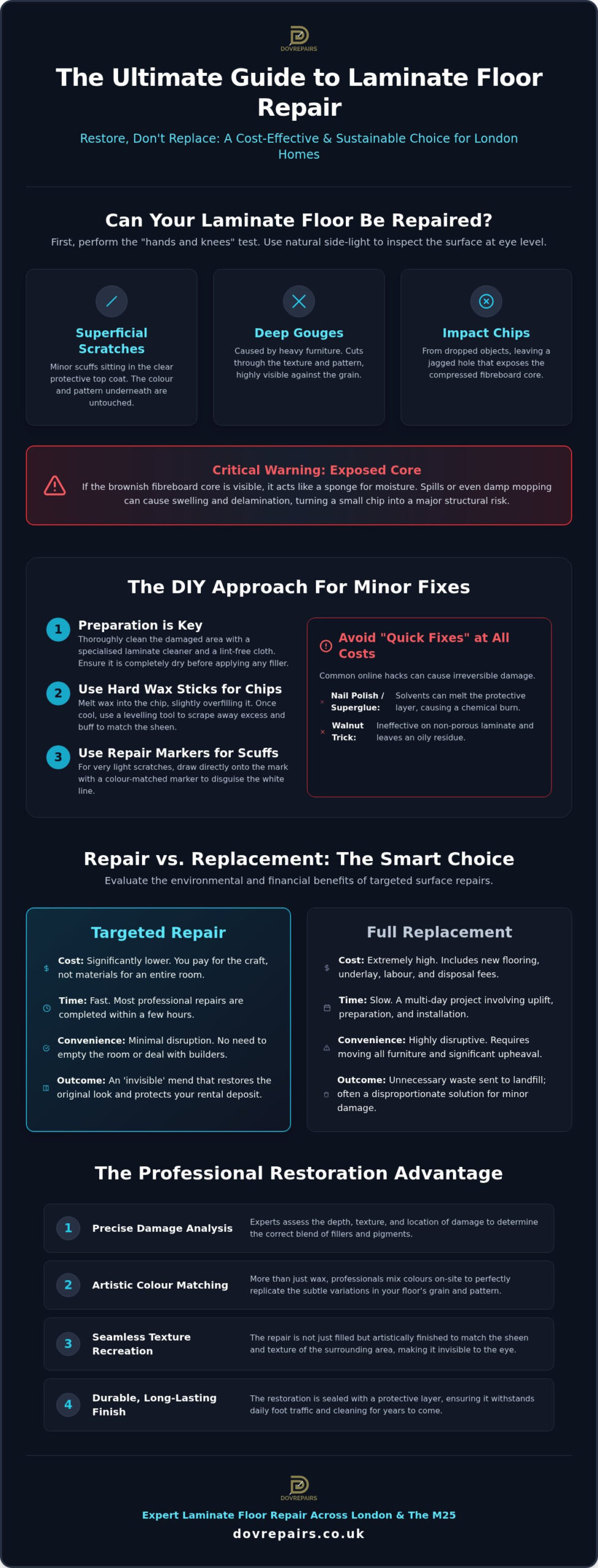
Before you decide to replace your entire floor, you need to understand exactly what has happened to the surface. Most homeowners in the capital assume that a single deep scratch means the end of their flooring, but often, a professional laminate floor repair London specialist can restore the surface to a distraction-free finish. Start by performing the “hands and knees” test. Turn off the overhead lights and use natural side-light from a window to inspect the floor at eye level. This reveals whether the damage is a superficial scuff in the clear wear layer or a deeper breach into the decorative paper and core.
Identifying the specific type of damage is the first step in the restoration journey:
- Superficial Scratches: These sit in the clear protective top coat and haven’t reached the colour or pattern underneath.
- Deep Gouges: Usually caused by dragging heavy furniture, these cut through the texture and are highly visible against the surrounding grain.
- Impact Chips: These occur when heavy objects like mugs or tools fall, often leaving a jagged hole that exposes the compressed fibreboard core.
When to Repair and When to Worry
You should pay close attention if a chip exposes the brownish fibreboard core. Laminate is essentially a sandwich of materials, and once that core is visible, it acts like a sponge for moisture. In a busy London kitchen, even small spills or damp mopping can cause the edges of the damage to swell. This leads to “peeling” or delamination, which is far harder to fix than a standard scratch. Whilst a scuff is an aesthetic annoyance, an open chip is a structural risk that requires prompt attention to prevent the damage from spreading across the plank.
London Property Types and Flooring Stress
London’s diverse housing stock presents unique challenges for hard flooring. In Victorian conversions, uneven subfloors often create “bounce” or specific stress points where the laminate planks meet. This movement can cause the interlocking joints to fail or lead to chips along the edges of the boards over time. Conversely, modern apartments in the M25 area often suffer from “snagging” issues. These are minor marks or trade damage left behind during the construction process. Whether it is the result of stiletto heels in a city flat or heavy furniture in a Kent period home, identifying these stress points early helps you choose the right restoration path rather than opting for a full, unnecessary replacement.
DIY Laminate Floor Repair: Fixing Scratches and Minor Chips
If your assessment reveals only minor surface wear, you might be able to handle the restoration yourself. Small scuffs and shallow chips often respond well to a patient hand and the right materials. Before you begin, gather a dedicated laminate repair kit containing hard wax sticks, a battery-operated melting tool, and a variety of repair markers. It’s vital to avoid “quick fixes” found on social media, such as using nail polish or superglue. These substances contain solvents that can permanently melt the protective wear layer of your flooring, turning a small scratch into a noticeable chemical burn.
Preparation is the most important step in any laminate floor repair London project. Even tiny particles of dust or oily residue from floor cleaners will prevent fillers from bonding correctly. Use a clean, lint-free cloth and a specialised laminate cleaner to strip away any surface contaminants. Ensure the area is completely dry before applying any wax or ink, as trapped moisture will cause the repair to fail within weeks.
Step-by-Step: Using a Laminate Repair Kit
Success with wax sticks depends on your ability to replicate the base colour of the plank. Always test your selected wax shade on a hidden corner or inside a cupboard first. Once you’ve found the right match, use the melting tool to drop small amounts of wax into the chip. It’s better to slightly overfill the void, as the wax will contract as it cools. Use the plastic levelling tool provided in your kit to scrape away the excess, keeping it flush with the surrounding surface. Finish by buffing the area with a soft cloth to match the surrounding sheen level, ensuring the repair doesn’t catch the light.
Fixing Superficial Scuffs and Scratches
For very light scratches that haven’t reached the core, repair markers are your best friend. These pens allow you to draw directly onto the scratch to disguise the white line often left by high-heeled shoes or pet claws. Whilst the “walnut trick” (rubbing a nut over wood to release oils) is a common suggestion, it’s often too greasy for laminate surfaces and attracts dirt. Professional-grade touch-up pens are far more reliable. Once you’ve disguised the mark, apply a tiny amount of protective sealant to lock in the colour and prevent moisture from creeping under the wear layer. If the damage feels too extensive for a home kit, seeking professional wood and laminate floor repairs can provide a more durable, guaranteed result for your London home.
The Professional Restoration Process: Achieving Invisible Results
Professional laminate floor repair London is a meticulous craft that goes far beyond simply filling a hole with wax. Whilst DIY kits offer a basic mask for minor marks, a specialist restoration focuses on the structural and aesthetic integration of the repair. We follow an “Invisible Repair” philosophy, which means our goal is to create a distraction-free finish where the eye no longer pauses at the site of the former damage. This level of quality requires a multi-layered approach, beginning with advanced surface preparation to ensure the repair lasts for years rather than weeks.
Longevity depends entirely on the foundation. We use specific primers to create a chemical bond between the original laminate and our restoration resins. This step is crucial because laminate is a non-porous material; without a chemical anchor, fillers can easily pop out during routine cleaning or under the pressure of foot traffic. By preparing the surface correctly, we ensure that the restoration becomes a permanent part of the plank, resisting moisture and temperature changes common in London homes.
Advanced Colour Matching Techniques
Laminate flooring is rarely a single, flat colour. Most modern designs feature complex, variegated patterns that mimic natural wood, including subtle shifts in tone and highlights. Our specialists don’t rely on pre-mixed fillers. Instead, we mix primary pigments on-site to create a bespoke base tone that matches the specific age and light-exposure of your floor. We then use fine brushes to hand-paint the intricate wood grain patterns, replicating “character” features like knots and mineral streaks. By layering multiple tints simultaneously, we recreate the visual depth of the original plank, making the repair virtually impossible to spot under any lighting conditions.
Reconstructing the Surface Texture
A repair can be colour-perfect but still stand out if the texture is wrong. If your floor has a deep, embossed grain and the repair is smooth, it will catch the light and reveal itself. We carefully reconstruct the contour and level of the damaged area to match the surrounding surface precisely. This involves manipulating the filler whilst it is pliable to mimic the tactile feel of the wood. Finally, we apply a specialist lacquer to match the sheen level, whether your floor is a modern ultra-matte, a classic silk, or a high-gloss finish. This final seal doesn’t just provide the right look; it creates a hard-wearing barrier that protects the repair from the rigours of daily life.
Repair vs. Replacement: Making the Sustainable Choice
Choosing to restore rather than replace is often the most sensible path for homeowners across the capital. When considering laminate floor repair London, the decision often comes down to logistics rather than just aesthetics. Whilst a single damaged plank might seem like a small issue, the reality of replacing it involves hidden costs and significant disruption that many people don’t anticipate until the work begins. Repairing the existing surface is a faster, cleaner, and more ethical way to maintain your home without the upheaval of a full construction project.
For London tenants, the stakes are even higher. A visible chip or deep scratch in a high-traffic hallway can lead to a substantial deduction from a security deposit. Landlords frequently cite flooring damage as a reason to withhold funds, often claiming the entire room needs a new floor to ensure a match. A professional restoration provides a cost-effective way to hand back your keys with confidence, knowing the floor looks as good as the day you moved in. It’s a proactive step that saves thousands of pounds compared to a full floor replacement. If your property has also sustained damage to tiled surfaces, our specialist bathroom wall tile repair London service can help you address chipped or cracked tiles with the same precision craftsmanship, ensuring every surface in your home is deposit-ready.
The Logistics of Floor Replacement
Modern laminate flooring uses a click-lock system that makes installation quick but replacement difficult. If a damaged plank is located in the centre of a room, a fitter often has to lift every board from the nearest wall just to reach the problem area. This process frequently damages the delicate tongues and grooves of the surrounding boards, leading to a “domino effect” of repairs. Finding an exact match for a floor installed only three or four years ago is nearly impossible. This leaves you with a patchwork finish that ruins the room’s flow. If you want to avoid the upheaval of a full installation, our wood and laminate floor repairs offer a stress-free alternative that preserves your original flooring.
Sustainability and the Circular Economy
Every year, tonnes of perfectly functional flooring end up in UK landfills simply because of minor surface damage. Laminate is particularly difficult to recycle due to its composite nature, making restoration the only truly eco-friendly choice. By choosing a professional laminate floor repair London, you are participating in the circular economy by extending the life of your materials. We focus on “Repair First” as a standard, helping Londoners reduce their carbon footprint whilst maintaining high standards of craftsmanship. A professional restoration is a permanent fix, unlike a DIY bodge that might only last a few months. It is an investment in longevity that respects both your property and the environment.
Expert Laminate Floor Repair in London: The DovRepairs Solution
Our on-site restoration service is designed to be as non-disruptive as possible. We understand that your time is valuable, which is why we focus on efficient, high-quality repairs that are usually completed within a few hours. By choosing restoration, you are opting for a cleaner, quieter alternative to the dust and noise of a full floor installation. We take pride in our ability to make damage virtually disappear, allowing you to enjoy your home without the constant distraction of a visible flaw in your flooring. This approach is not just about aesthetics; it is about providing a durable solution that stands up to the rigours of daily life.
From our central base in Dartford, we provide comprehensive coverage across Greater London and the M25 motorway. This local presence is essential for providing a dependable service to our diverse client base. We are familiar with the unique challenges of London property maintenance, from the parking restrictions of the West End to the specific floor stresses found in period conversions. Booking your repair is a straightforward process. To get a quick and accurate estimate, simply contact us with a description of the damage. We recommend including clear, well-lit photographs from several angles. Providing a sense of scale, perhaps by placing a 50p piece next to the scratch or chip, helps us understand the depth and size of the restoration required before we arrive at your door.
Our Multi-Surface Expertise
Reclaiming Your Floor’s Original Beauty
Maintaining your home shouldn’t involve the stress of a full renovation every time a heavy object falls. You now have the tools to distinguish between simple scuffs and structural chips, alongside an understanding of why professional restoration is the most sustainable choice for our city. By choosing laminate floor repair London, you’re not just fixing a surface; you’re extending the life of your materials and keeping waste out of landfills whilst protecting your security deposit.
Our team is dedicated to providing a distraction-free finish through meticulous colour matching and grain replication. We offer guaranteed workmanship across the capital, ensuring your flooring remains a beautiful, reliable part of your living space. If you’re ready to see that unsightly gouge disappear, we invite you to Request a Free Quote for Your London Floor Repair today. We proudly serve all of London and the M25 from our Dartford base, delivering eco-friendly restoration that puts your peace of mind first. Your floor has plenty of life left in it; let’s help you reveal it once more.
Frequently Asked Questions
Can you repair a laminate floor that has water damage or swelling?
Repairing structural water damage is generally not possible once the fibreboard core has swollen and peaked at the joints. Whilst surface-level chips and scratches can be restored, structural expansion from significant leaks usually requires the affected planks to be replaced. We recommend addressing the moisture source immediately to prevent the damage from spreading to adjacent boards and compromising the integrity of the entire floor.
How long does a professional laminate floor repair take to complete?
Most individual repairs, such as fixing a deep gouge or a few impact chips, take between one and three hours to complete. The exact duration depends on the complexity of the wood grain we need to replicate and the number of layers required for the restoration. Because our process is on-site and efficient, you won’t have to deal with the prolonged disruption associated with traditional flooring replacement.
Will the repair be completely invisible once finished?
Our goal is to provide a distraction-free finish that is virtually invisible to the naked eye under normal lighting conditions. Whilst no repair can technically be 100% identical to the factory finish, our advanced colour matching and hand-painted grain replication make the damage extremely difficult to spot. This high standard of craftsmanship ensures that your floor’s aesthetic flow is restored without the eye being drawn to the former site.
Can I walk on the floor immediately after a professional repair?
You can typically walk on the repaired area almost immediately after our specialist has finished the curing process. We use high-quality resins and lacquers that set quickly under controlled conditions. However, we do advise that you avoid heavy foot traffic, dragging furniture, or using wet cleaning products on the specific repair site for at least 24 hours to ensure the chemical bond reaches its maximum strength and durability.
How much does it typically cost to repair a chip in a laminate floor?
The cost of a professional laminate floor repair London varies based on the extent of the damage and the number of areas requiring attention. Whilst we cannot provide specific pricing here, choosing restoration is almost always more cost-effective than the total expense of purchasing new materials and paying for a full installation. For a bespoke estimate tailored to your home’s needs, we encourage you to send us clear photographs of the damage.
Do you provide laminate floor repair services for commercial properties in London?
Yes, we provide specialist restoration services for a variety of commercial properties across the City and the M25. This includes retail spaces, offices, and showrooms where high foot traffic often leads to surface wear. Our efficient on-site process is ideal for businesses as it minimises downtime and avoids the logistical nightmare of closing a premises for a full floor replacement, ensuring your professional environment remains pristine and safe.
What is the difference between laminate and engineered wood repair?
The main difference lies in the surface material and the restoration technique required. Laminate is a photographic print under a wear layer, requiring artistic grain replication with resins. Engineered wood has a real timber veneer that can sometimes be lightly sanded or filled with wood-specific waxes. Both require a keen eye for colour matching, but the chemical primers we use for laminate floor repair London are specifically formulated to bond with synthetic surfaces. If your property has real timber boards rather than laminate, our engineered wood floor repair London service uses specialist techniques tailored to the unique properties of natural wood veneers.
How do I prevent my laminate floor from scratching in the future?
Prevention is key to maintaining a beautiful floor over the long term. We recommend using high-quality felt pads on the legs of all furniture and placing rugs in high-traffic entranceways to trap abrasive grit. Avoid wearing stiletto heels indoors and keep pet claws trimmed to reduce surface scuffs. Regularly cleaning with a microfibre mop and a specialised laminate spray will also prevent the build-up of dirt that can act like sandpaper underfoot.