
Replacing a scratched undermounted sink in a London kitchen can cost thousands once you factor in bespoke worktop modifications and plumbing fees. It’s an overwhelming expense for what is often a surface-level issue that doesn’t require a skip. You likely invested heavily in your kitchen’s modern aesthetic; seeing it ruined by unsightly scratches or dull patches is deeply frustrating. Whether you’re a homeowner protecting your investment or a tenant worried about a rental deposit, the fear of causing more damage with a DIY kit is completely understandable.
Our guide to stainless steel sink scratch repair London reveals how professional restoration removes these marks while saving you the significant cost and hassle of a full replacement. You’ll discover the technical process of re-passivation that restores the metal’s biological resistance and learn why choosing repair is the most sustainable, stress-free path for your home in 2026. We will walk you through the specialist techniques used to blend damage away, ensuring your kitchen remains the polished heart of your home.
Key Takeaways
- Understand how scratches damage the microscopic protective layer of your sink and why this leads to a loss of original lustre over time.
- Discover how specialist stainless steel sink scratch repair London techniques restore the factory grain finish; this prevents the patchy, dull appearance often caused by home repair kits.
- Learn about the technical re-passivation process, which chemically heals the metal surface to ensure long-lasting durability and resistance to corrosion.
- Realise the eco-friendly benefits of repairing your existing fixture, which saves you from the high costs and environmental impact of a full kitchen renovation.
Understanding Stainless Steel Scratches: Why Your London Sink Loses Its Lustre
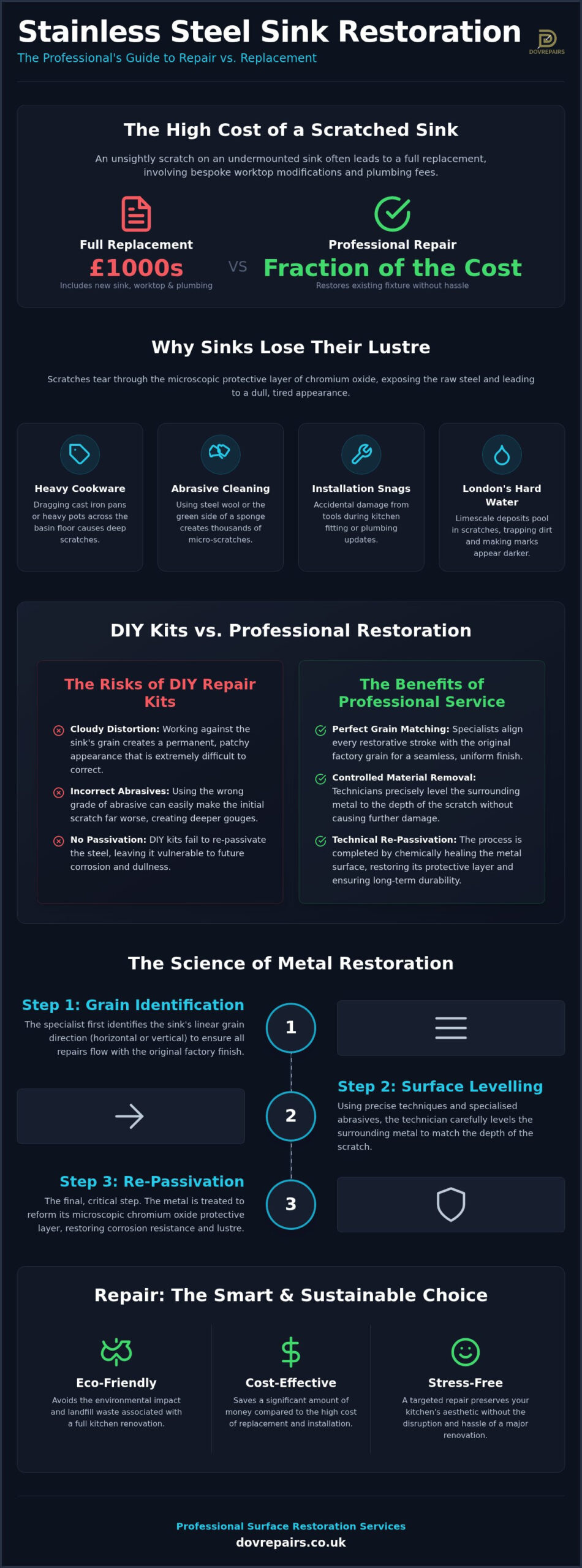
Stainless steel is often misunderstood as an indestructible material, yet its beauty relies on a delicate chemical balance. To truly understand why your sink looks tired, we must look at the properties of stainless steel. This alloy is protected by a microscopic, self-healing “passive layer” of chromium oxide. Whilst this layer is incredibly thin, it’s the only thing standing between your sink and the elements. When you drop a heavy cast iron pan or use an abrasive scouring pad, you physically tear through this barrier. This exposes the raw steel beneath to oxygen and moisture, causing the metal to lose its factory-fresh reflection and appear dull.
In busy London households, several factors contribute to surface degradation. With the “Improve, Not Move” trend seeing 26% of homeowners choosing renovation over relocation in 2026, maintaining existing fixtures has never been more vital. Common causes of damage include:
- Heavy Cookware: Dragging Dutch ovens or roasting tins across the basin floor.
- Abrasive Cleaning: Using the “green” side of a sponge or steel wool, which creates thousands of micro-scratches.
- Installation Snags: Accidental damage from tools during a kitchen fitting or plumbing update.
When these incidents occur, the need for stainless steel sink scratch repair London specialists becomes clear. The metal cannot always heal itself if the damage is deep or repetitive, leading to a permanent loss of lustre.
The Role of London’s Hard Water in Surface Damage
Living within the M25 area means dealing with some of the UK’s hardest water. Limescale, or calcium carbonate, is a persistent foe for any polished surface. When a scratch occurs, it creates a tiny valley where hard water can pool and evaporate. This leaves behind mineral deposits that trap dirt and grease, making even a shallow mark appear much darker and more prominent over time. Limescale-induced oxidation is a primary cause of dullness in London kitchens, as the minerals physically block the metal’s ability to reform its protective chromium layer.
Surface Scratches vs. Deep Gouges: Assessing the Damage
Not every mark requires the same level of intervention. Hairline “swirl marks” are usually just light abrasions in the top layer of the finish. You can often identify the severity using the “fingernail test” by gently running your nail across the scratch. If your nail glides over it, it’s a surface issue that can be polished out. If it catches, you’re looking at a deeper gouge. Whilst most surface damage is perfectly suited for professional restoration, structural piercing or holes require a full replacement. We focus exclusively on the craft of repair, as it’s the most sustainable way to keep your kitchen looking its best.
The Science of Metal Restoration: Grain Direction and Passivation
Restoration is far more than a simple aesthetic fix. It’s a technical process of controlled material removal where a specialist carefully levels the surrounding metal to match the depth of a scratch. This requires a precise understanding of the specific alloy in your kitchen. Most London homes feature 304-grade steel. It’s the industry standard for domestic sinks because it offers fantastic durability; however, it’s slightly softer than the 316-grade steel typically found in marine or industrial settings. This relative softness makes 304-grade steel highly repairable, but it also means the metal is easily damaged by improper technique or the wrong abrasive grade.
Identifying the Grain Direction in Your Sink
Almost all modern sinks possess a linear “grain” or “brushing” created during the manufacturing process. This isn’t just a decorative feature. It’s the physical texture of the metal surface. Before beginning any stainless steel sink scratch repair London, you must identify whether the grain runs horizontally, vertically, or in a circular pattern. Working against this grain is the most common mistake in amateur attempts. It creates a permanent, cloudy distortion that’s incredibly difficult to hide later. A professional ensures every restorative stroke aligns perfectly with the original brushing, maintaining that crisp, uniform factory finish you expect from a premium installation.
What is Passivation and Why is it Critical?
After the surface is levelled and the scratches are removed, the metal must undergo re-passivation. This is the spontaneous formation of the microscopic chromium oxide layer that protects your sink from the environment. For this to happen correctly, the metal must be completely free of contaminants. Professional technicians ensure the surface is “de-grimed” and stripped of free iron particles that can be left behind by low-quality steel wool or improper sanding discs. If these particles remain trapped, they lead to “tea staining” or unsightly rust spots that compromise the metal’s integrity over time.
Practising Sustainable Surface Care by using the right maintenance products ensures this protective layer remains robust for years. If your sink has lost its shine or suffered deep marks, reaching out to a qualified restoration expert can save the surface before the damage deepens. Choosing a specialist avoids the risk of trapping contaminants, ensuring your sink remains both hygienic and beautiful.
DIY Repair Kits vs Professional Restoration: Evaluating the Risks
It’s tempting to think that a small scratch only needs a quick rub with an abrasive pad to disappear. Many homeowners in the M25 area turn to £30 DIY kits found on online marketplaces, which typically contain a few generic sanding pads and a small tub of polishing paste. Whilst these kits promise a simple fix, they lack the precision required for high-end kitchen fixtures. The contents are often “one-size-fits-all,” failing to account for the specific grade or grain density of your metal. Using the wrong abrasive can quickly turn a minor scratch into a permanent scar, potentially ruining a designer sink worth hundreds of pounds.
Mastering stainless steel sink scratch repair London requires years of experience, particularly in the art of blending. This is the most difficult skill to acquire in metal restoration. A professional doesn’t just sand the scratch; they carefully transition the new finish into the surrounding area so the repair is invisible to the naked eye. Without this expertise, you risk creating a finish that looks inconsistent and patchy, drawing even more attention to the original damage.
The Danger of “Over-Polishing” and Shiny Patches
One of the most common issues we encounter is “shiny spot” syndrome. This occurs when a DIY attempt focuses too aggressively on a single area, accidentally creating a mirror-finish patch on a sink that was originally brushed or satin. This bright, reflective spot is often far more noticeable and distracting than the scratch it was meant to hide. Professional commercial hard surface repair London avoids this by using a technique called feathering. By spreading the restorative work across a larger surface area, a specialist ensures that light reflects uniformly across the entire basin, maintaining the factory-standard aesthetic of your kitchen.
When to Call a Specialist Surface Restorer
Certain situations make DIY attempts far too risky. If you have an undermount sink, for example, the unit is bonded directly to the underside of your stone or laminate worktop. Replacing such a sink is a logistical nightmare that involves plumbers and worktop specialists, often costing thousands of pounds. For tenants, the stakes are equally high; a botched repair could lead to the loss of a significant rental deposit. Choosing a professional service provides the security of a workmanship guarantee and the peace of mind that the job is done right the first time. If your kitchen has suffered from multiple mishaps, you might also consider our bath chip repair London service to restore several household surfaces in a single, efficient visit. Similarly, if your units show signs of wear alongside your sink, professional kitchen cabinet door repair London services can address scuffs and peeling edges without the disruption of a full refit. For properties with high-traffic corridors and communal areas, fire door surface repair London specialists can similarly restore compliance-safe surfaces without the significant cost of a full doorset replacement.
The Professional Repair Process: How Specialists Restore the Factory Finish
Restoring a metal surface to its original condition is a disciplined, multi-stage process that requires both technical precision and a craftsman’s eye. It isn’t merely about “sanding out” a mark; it’s a methodical engineering task designed to level the metal without compromising its structural integrity. When performing stainless steel sink scratch repair London, our specialists follow a structured path that ensures the repair is durable, hygienic, and aesthetically perfect. This professional approach avoids the patchy, inconsistent results often seen with home kits and ensures your sink remains a centrepiece of your kitchen.
Step 1: Surface Preparation and Grain Mapping
Before any abrasive touches the metal, the surface must be surgically clean. Our technicians begin by removing every trace of London limescale, grease, and cleaning residue. Any microscopic debris left on the surface can get trapped under the sanding pads, causing deep, secondary scratches. Once de-grimed, we use high-intensity lighting to perform grain mapping. This allows us to see the exact orientation and density of the factory brushing. We then carefully mask off nearby worktops, taps, and cabinetry with protective tape to ensure the restoration work is strictly confined to the sink basin.
Step 2: Progressive Abrasive Honing
The core of the repair involves “bringing down” the surrounding metal to the depth of the scratch. We achieve this using a series of progressive abrasives, starting with a grit level specific to the damage and moving through increasingly fine grades. Precision is everything. We often employ a “wet sanding” technique, using specialist lubricants to keep the metal cool. This prevents the steel from warping due to frictional heat, which is a common risk when using high-speed power tools. Every stroke is steady and linear, carefully mimicking the movement of the original factory machinery to maintain a uniform texture.
Step 3: Blending and Final Passivation
The final stage is where the skill of blending, or “feathering,” comes into play. We don’t stop at the edge of the scratch; instead, we gradually taper the new finish into the original surface so there are no visible boundaries. After the mechanical work is complete, we apply protective finishers that aid the initial passivation process. These oils ensure that the chromium oxide layer reforms uniformly, protecting the raw steel from the oxygen and moisture in your kitchen. The final result should be invisible under standard kitchen lighting, leaving the basin looking as though the damage never happened.
If your sink has suffered from heavy use or accidental damage, you don’t have to live with the eyesore or face a costly replacement. You can book a specialist stainless steel repair today to see how our conscientious restoration process can save your kitchen’s aesthetic.
Sustainable Surface Care: Why Repair is the Smart Choice for London Homeowners
Choosing to repair rather than replace is a decision that benefits both your bank balance and the environment. Whilst stainless steel is infinitely recyclable, the process of melting down and reforming metal is incredibly energy-intensive. It involves significant carbon emissions from industrial smelting and the heavy logistics of transporting new goods across the country. By opting for on-site stainless steel sink scratch repair London, you eliminate the need for new manufacturing and the associated packaging waste. Based in Dartford, we act as a reliable partner for homeowners across the M25, ensuring that high-quality kitchen fixtures remain in use rather than ending up in a landfill.
Saving Your Security Deposit: A Tenant’s Guide to Surface Damage
Embracing a “repair over replace” philosophy is one of the most effective ways to manage a modern property sustainably. Many older sinks are made of high-grade, thick-gauge steel that is far more durable than the cheaper, thinner replacements available today. Restoring these surfaces preserves the original quality of your kitchen whilst preventing unnecessary waste. Our expertise in “snagging” for national home builders means we understand the high standards required for a perfect finish. Choosing restoration isn’t just a smart financial move; it’s a commitment to reducing the environmental impact of London’s housing stock. It ensures that your kitchen remains functional and beautiful without the disruption of a full-scale replacement project. The same principle applies throughout your property: professional fire door surface repair London services can restore scratched or chipped doorsets to a compliance-safe, pristine condition without the expense and delay of a full replacement. If your cabinets also show signs of wear, exploring kitchen cabinet door repair London options alongside your sink restoration can deliver a comprehensive, showroom-standard result in a single visit.
Contact DovRepairs for a professional stainless steel restoration quote today.
Restoring Your Kitchen’s Centrepiece with Confidence
Maintaining a pristine kitchen doesn’t have to mean facing the high costs and logistical headaches of a full sink replacement. As we’ve explored, professional stainless steel sink scratch repair London is a technical craft that goes far beyond simple polishing. By focusing on precise grain-matching and the critical chemical process of re-passivation, our specialist technicians can erase unsightly damage whilst ensuring the metal remains resistant to future corrosion. This approach not only preserves the high-quality fixtures already in your home but also supports a more sustainable, “repair over replace” philosophy that reduces environmental waste.
Whether you’re a tenant looking to secure your rental deposit or a homeowner protecting a bespoke kitchen installation, our Dartford-based team is ready to help. We serve all London boroughs with a commitment to invisible blending and disciplined craftsmanship. You can reclaim the polished, hygienic finish of your basin without the stress of structural building work or plumbing changes. If you’re ready to see the difference that expert restoration can make, please Request a Professional Surface Repair Quote today. We look forward to helping you restore the lustre and longevity of your home’s surfaces.
Frequently Asked Questions
Can all scratches be removed from a stainless steel sink?
Most surface scratches and deeper marks can be successfully removed through our restoration process. However, we cannot fix structural damage where the metal has been completely pierced or thinned to the point of failure. Our technicians assess the depth of the damage using the fingernail test mentioned earlier. If the sink’s integrity is compromised, we will advise you honestly, as we specialise in surface repairs rather than full replacements.
Will the repaired area of my sink eventually rust?
No, the repaired area will not rust if the passivation process is carried out correctly by a specialist. We ensure the metal is chemically cleaned of free iron particles before the protective chromium oxide layer reforms. This technical step is vital for long-term durability. Without it, raw steel remains exposed to London’s moisture and oxygen; this is why DIY attempts often result in unsightly “tea staining” or orange rust spots.
How long does a professional stainless steel scratch repair take?
A typical stainless steel sink scratch repair London session usually takes between two and four hours to complete. The exact duration depends on the number of scratches and the severity of the damage. Since we operate as a mobile service across the M25 area, we complete all work on-site in a single visit. This efficiency means your kitchen remains functional with minimal disruption to your daily routine or household schedule.
Is it possible to repair a sink that has a mirror finish rather than a brushed finish?
Yes, we can restore both mirror-polished and brushed-satin finishes. Mirror finishes require a different set of progressive abrasives and high-speed buffing compounds to achieve a distortion-free reflection. Whilst brushed finishes rely on precise grain-matching, mirror surfaces demand a perfectly flat, level plane to avoid “funfair mirror” effects. Our technicians possess the specialist tools and expertise needed to replicate either factory finish, ensuring the repaired area blends seamlessly with the rest of the basin.
Do I need to empty my kitchen cabinets before the technician arrives?
You don’t need to empty the cupboards beneath the sink, as our work is focused entirely on the top surface. We do ask that you clear the sink basin and the surrounding worktop areas to give our specialist enough space to work. We take great care to mask off your taps and cabinetry with protective materials, ensuring that your kitchen remains clean and protected throughout the entire restoration process.
Can you fix scratches on other stainless steel appliances like fridges or hobs?
Yes, our restoration techniques are highly effective on a wide range of stainless steel surfaces, including refrigerator doors, hobs, and splashbacks. These appliances often use the same 304-grade steel as kitchen sinks and are equally prone to accidental damage during cleaning or installation. While we focus on restoring the aesthetic finish of your kitchen equipment, for functional mechanical issues, Rhino Appliance Repair provides a great example of the expert technical service required to keep high-end household appliances in top condition. If you have multiple items that require attention, we can often address them during the same visit to provide a more comprehensive and cost-effective surface restoration solution.
Is the repair process messy or will it create dust in my kitchen?
The process is remarkably clean because we primarily use “wet sanding” techniques. By using specialist lubricants, we trap any metal particles in a slurry that is easily wiped away, preventing fine dust from becoming airborne in your home. We also use high-quality masking tape and protective sheeting to shield your worktops and floor. Our goal is to leave your kitchen in the same tidy condition we found it, but with a beautifully restored sink.
Do you offer a guarantee on your stainless steel restoration work in London?
Yes, we provide workmanship guarantees on all our stainless steel restoration projects throughout the M25 region. We take immense pride in our craftsmanship and want you to feel confident in the longevity of the repair. This guarantee covers the quality of the finish and the technical passivation of the metal. It’s part of our commitment as a conscientious specialist to provide reliable, high-quality results that meet the expectations of London homeowners and tenants.